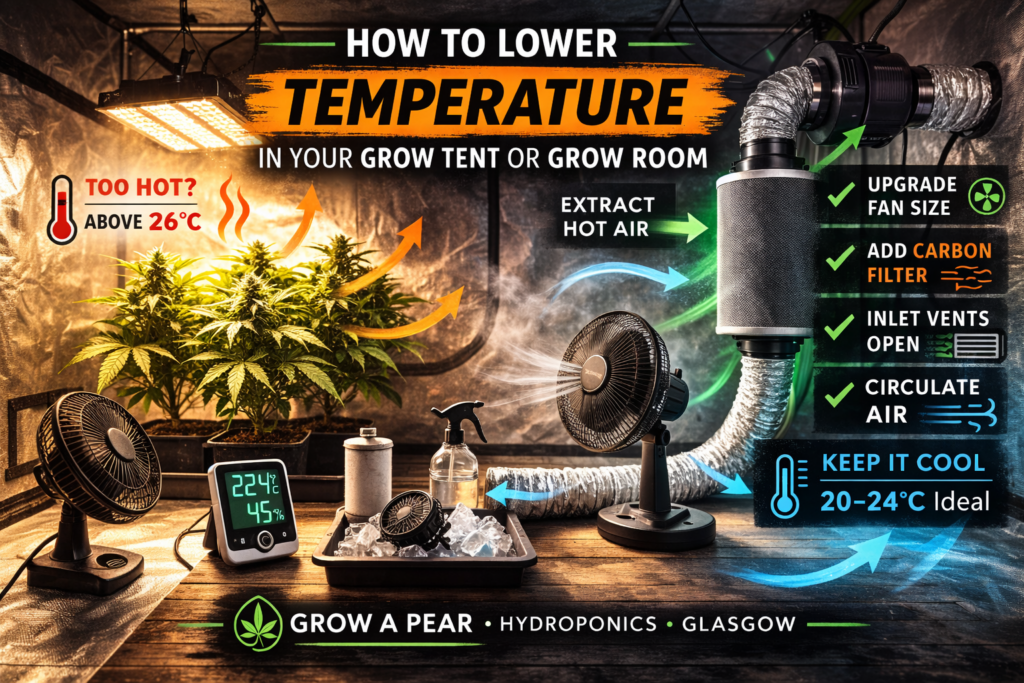
If your grow tent or grow room is running too hot, you’re not alone. High temperatures can slow plant growth, reduce yields, and create humidity problems.
The good news? Most temperature issues can be fixed with proper airflow, lighting adjustments, and environmental control. Below is a practical guide to reducing grow tent temperatures effectively.
Why Grow Tent Temperatures Get Too High
Grow spaces overheat for a few common reasons:
- Incorrect fan sizing
- Poor airflow circulation
- Lights producing too much heat
- Ballasts placed inside the tent
- Warm intake air
- Poor ventilation design
Before adding more equipment, start by checking your airflow and extraction setup.
1. Use the Correct Size Extraction and Intake Fans
Your inline extraction fan must match the size of your tent or grow room. If the fan is too small, hot air builds up faster than it can be removed.
Larger tents require higher CFM extraction fans, and proper intake airflow must support the system.
If you’re unsure what size fan you need, visit our hydroponics shop in Glasgow and we’ll help calculate the correct setup for your space.
2. Add Clip-On or Oscillating Fans
Clip-on fans and oscillating stand fans help:
- Prevent hot spots
- Improve air circulation
- Strengthen plant stems
- Maintain consistent temperature
Air movement inside the tent is just as important as air extraction.
3. Cool the Air Before It Enters the Tent
Instead of only cooling the tent itself, cool the room your intake fan pulls air from.
You can:
- Use air conditioning
- Improve room ventilation
- Avoid pulling air from hot lofts or enclosed spaces
Cooler intake air leads to a cooler grow tent.
4. Run Your Grow Lights at Night
One of the simplest fixes is running your lights during nighttime hours when ambient temperatures are lower. This significantly reduces heat load, especially during warmer months.
5. Reduce Light Intensity (If Using Variable Ballasts)
If your lighting system allows it, lower the ballast power slightly or increase the distance between the light and the canopy. Even small reductions in wattage can noticeably reduce heat output.
6. Keep Ballasts Outside the Grow Tent
Ballasts generate heat. If they’re placed inside the tent, that heat builds up quickly. Mounting them outside the tent or grow room immediately reduces internal temperatures.
7. Use CO₂ to Help Plants Tolerate Higher Heat
If temperatures are still slightly high, controlled CO₂ supplementation can help plants tolerate warmer conditions. However, this should only be used once airflow and ventilation are properly optimized.
Ideal Temperature Range for Most Indoor Grows
- Vegetative stage: 22–28°C
- Flowering stage: 20–26°C
- Nighttime: Slightly cooler
Keeping temperatures stable is more important than chasing exact numbers.
Need Help Choosing the Right Equipment?
If you’re based in Glasgow and struggling with high grow tent temperatures, visit:
Grow a Pear Hydroponics
78 Stanley Street, Kinning Park, Glasgow
Phone: +44 141 429 5008
For expanded stock and warehouse availability, visit our sister store:
The Grow Shop
Unit 8, Block 8 Spiersbridge Terrace, Glasgow G46 8JH
Phone: +44 141 737 0377
Leave a Reply